
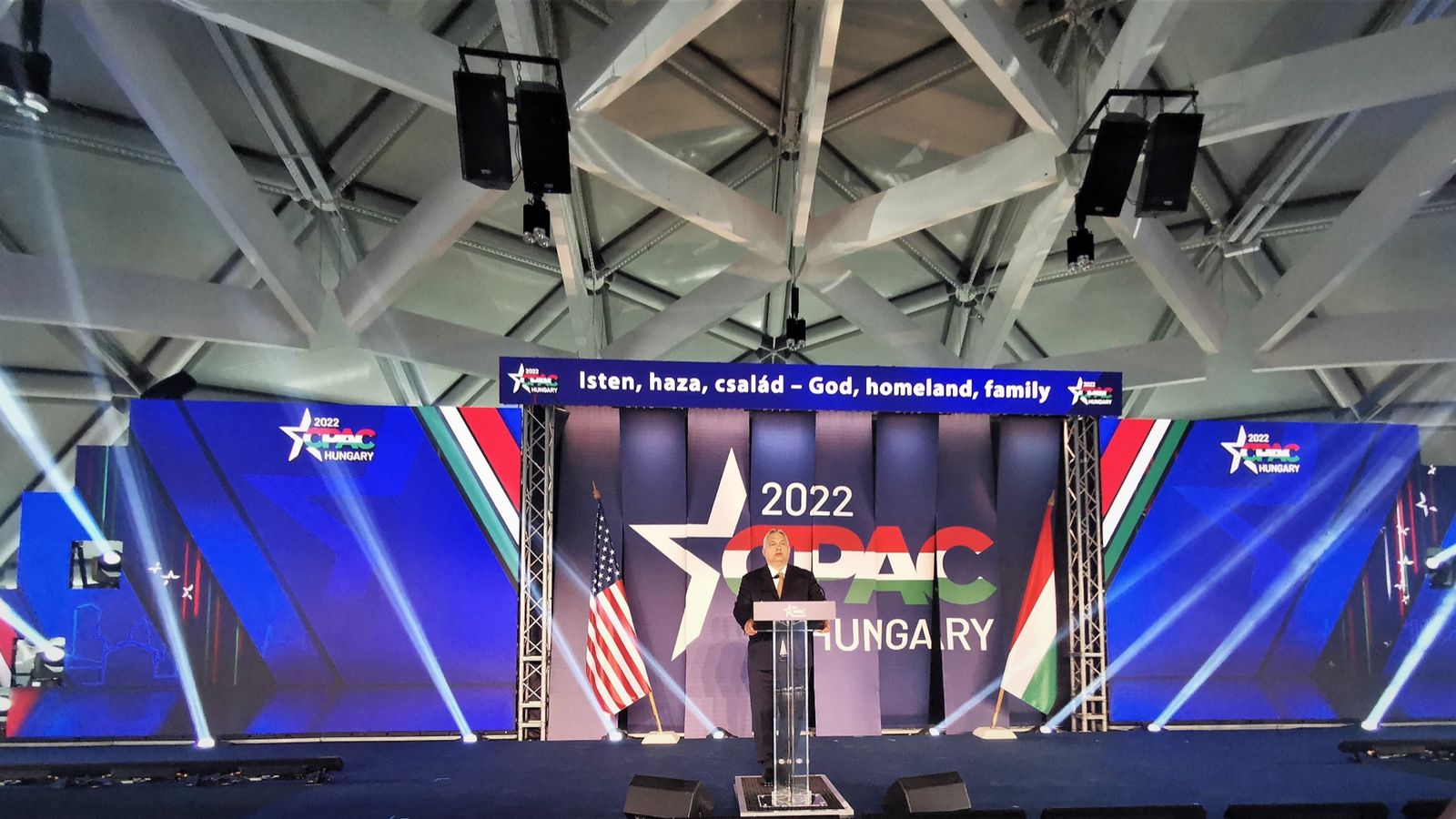
In the spring of 2022, hundreds of conservatives from the United States and around the world descended on a single city for the Conservative Political Action Conference, better known as CPAC, the premier gathering of right-wing activists, politicians, and media figures. But the venue was not Miami or Houston. It was Budapest. Hungary was hosting an international chapter of the American conservative movement’s signature event, and the choice was anything but accidental.
They came to study, and to celebrate, the work of Viktor Orban, a man who transformed himself from a liberal young revolutionary into Europe’s most successful illiberal democrat. Just months earlier, Tucker Carlson had traveled to Hungary to host his show for an entire week before it was later cancelled on Fox News. Advisers in Donald Trump’s orbit make what look like regular pilgrimages there.
All of which raises an obvious question: why Hungary? A country of fewer than ten million people, with an economy smaller than Louisiana’s, hardly seems like a natural object of American conservative attention. Yet for the MAGA movement as a whole, it has become something between a laboratory and a blueprint. What admirers see in the country is not just conservative policy, which is hardly unique.
Situation Brief
- Viktor Orban controls roughly two-thirds of Hungary’s parliament despite winning only about 53 percent of the vote, the product of systematic advantages engineered into the electoral system rather than overwhelming popularity.
- After his 2010 landslide, Orban’s Fidesz party rewrote the constitution, created “cardinal laws” requiring a two-thirds vote to change, packed the courts, and redrew districts, locking in advantages that future governments would find nearly impossible to reverse.
- Allied oligarchs bought up media outlets and consolidated them into a foundation called KESMA, which now controls roughly 80 percent of Hungarian media; state advertising flows overwhelmingly to friendly outlets.
- The 2015 refugee crisis turned Orban from a minor European figure into a celebrated strongman of the global right, complete with a border fence, a vilification campaign against George Soros, and rhetoric about defending “Christian Europe.”
- For American conservatives who feel perpetually outnumbered in media, academia, and culture, Orban offers not just shared values but a proof of concept: a way to use temporary victory to build permanent advantage.
What makes Hungary special is that Viktor Orban figured out how to win democratically, then rewrote the rules to make it incredibly hard to lose.
He has rewritten constitutions, packed courts, turned much of the media into a chorus, and forced his opponents to fight on an impossibly tilted playing field, all while keeping elections free enough to avoid complete international pariah status. This is the story of how he did it, why it captivates the American right, and why the same enthusiasm should unsettle anyone who cares about how democracies survive.
The Orban Revolution
Viktor Orban controls two-thirds of Hungary’s parliament despite having received just 53 percent of the vote. He has been in power for fifteen years and counting, and his party, Fidesz, has not lost a national election since 2010. This is not a story about overwhelming popularity. It is a story about systematic advantages built into the system itself.
It is worth being precise about what Hungary is and is not. It is not North Korea, where elections are pure theater. It is not Syria, where, under Bashar al-Assad, opposition to the government meant prison or worse. Elections happen in Hungary, there is a genuine and legitimate opposition, and votes are counted honestly. But Orban discovered something profound: you do not need to end democracy entirely if you can redesign it to reliably produce the result you want.
To understand that innovation, you have to know where Orban came from. In 1989, at twenty-six, he stood in Budapest’s Heroes’ Square demanding a Soviet withdrawal from Hungary. He co-founded Fidesz, the Alliance of Young Democrats, as an anti-communist movement advocating for democracy, free markets, and civil rights. Back then, his speeches could have been written by any European liberal.
From Liberal Revolutionary to Illiberal Democrat
Through the 1990s, Orban evolved from activist to politician. He served as prime minister from 1998 to 2002, establishing a reputation as a fairly conventional conservative leader. When he lost the 2002 election, he conceded normally and returned to opposition. In 2006, he lost again.
That second defeat is where the real change began. A leaked recording caught the Socialist prime minister admitting he had lied about the economy to win reelection, sparking uproar across the country. Protests broke out, and the Socialists’ credibility imploded. In that chaos, Orban saw an opportunity, not just to win the next election, but to ensure he would never lose again.
The 2008 financial crisis provided the conditions. Hungary’s economy crashed harder than many of its neighbors, and the Socialist government imposed brutal austerity to bring debt under control. By 2010, voters were desperate for change. Orban campaigned on restoring national pride and prioritizing economic stability, and the result was a landslide.
The Socialists collapsed to 19 percent. Fidesz won 53 percent of the vote, which Hungary’s electoral system translated into 68 percent of parliamentary seats. In Hungary, a two-thirds majority can change anything, including the constitution itself. Orban had won the power to remake the country, and that is exactly what he set out to do.
Engineering a Permanent Majority
He did not waste time. Within a year, Fidesz pushed through an entirely new constitution. Written without opposition input, it moved the country considerably to the right and packed the Constitutional Court with new members loyal to the government while limiting judicial power. But the real innovation was in the details.
The government created “cardinal laws,” special legislation covering fundamental areas like electoral systems, judicial organization, media regulation, taxation, and government structure. These laws govern everything from how district boundaries are drawn and judges appointed to how media outlets are supervised. Unlike normal laws that a simple majority can change, cardinal laws require a two-thirds vote, effectively constitutionalizing ordinary policy and ensuring that future opposition governments would find it nearly impossible to reverse Orban’s institutional changes.
Orban understood that democratic institutions are only as strong as the people running them, so he systematically replaced them. Not through dramatic purges, which would have caused an uproar at home and abroad, but through a slow, steady course of administrative changes that individually seemed minor but collectively added up to something dramatic.
Capturing the Courts and the Media
Take the judiciary. Rather than arresting judges, Orban simply lowered the mandatory retirement age from seventy to sixty-two. Overnight, nearly three hundred senior judges, many previously seen as opposed to Orbanism, were forced out. He created a new National Judicial Office to assign cases and appoint replacements, headed by a Fidesz loyalist.
The Constitutional Court was expanded from eleven to fifteen members, with Orban filling every new seat. Within two years, the judiciary transformed from independent into a reliable ally.
The media received its own special treatment. Orban’s oligarch allies, men who mysteriously developed a passion for journalism right after he took power, began buying outlets en masse: newspapers, radio stations, television channels, and news websites. By 2018, they controlled over five hundred media properties. Then, in an unprecedented move, every single one was “donated” to a new mega-foundation called KESMA.
The government declared this obvious monopoly exempt from competition laws, calling it a matter of national strategic importance.
Today, KESMA controls roughly 80 percent of Hungarian media. The government directs all state advertising, worth around 344 million euros annually, exclusively to friendly outlets, with 85 percent flowing to pro-government media while independent outlets are starved of revenue. What makes this so effective is that Hungary is a kind of linguistic island. Hungarian is unrelated to neighboring German, Slovak, or Romanian.
Unlike citizens of Venezuela, who can turn to Spanish-language media from, say, Colombia, Hungarians have no other options without learning a foreign language. When independent Hungarian media dies, it cannot be replaced by foreign alternatives, leaving a void filled largely by government messaging.
Watch on HomeFronts
Watch the full video analysis on the HomeFronts YouTube channel, presented by Simon Whistler.
The Mathematics of a Tilted Field
The electoral system got the most elegant treatment of all. Orban’s team redrew constituencies with surgical precision, packing opposition voters into as few districts as possible while spreading Fidesz supporters across many winnable seats. They granted voting rights to ethnic Hungarians in neighboring countries, a diaspora that votes roughly 95 percent for Fidesz by mail. And they tweaked the formula for allocating parliamentary seats to systematically advantage the largest party.
The math is staggering. In the 2014 election, Fidesz won just 44.9 percent of votes but captured 66.8 percent of seats. The diaspora vote alone, roughly 122,000 ballots that year, can swing close elections in the ruling party’s favor. Political scientists calculate that the opposition needs to win by a significantly larger total margin just to achieve a bare-bones parliamentary majority. In 2022, six opposition parties pulled together to form one united front and still could not overcome the built-in disadvantage.
The economic dimension completes the system. European Union structural funds provide about 4 percent of Hungary’s gross domestic product, billions meant for infrastructure and development. Under Orban, these funds flow primarily to his allies. The poster child is Lorinc Meszaros, Orban’s childhood friend from their tiny home village.
In 2010, Meszaros was a gas fitter working on pipes and boilers. Today, he is Hungary’s richest man, worth over a billion euros. In 2018 alone, his companies won 826 million euros in EU-funded contracts. Asked about his success, Meszaros credited “God, luck, and Viktor Orban.”
The message is not subtle: support the regime and prosper, oppose it and suffer economic isolation. In rural areas where a single EU-funded project might be the largest employer, this creates overwhelming pressure to fall in line. Mayors who back Fidesz see new highways and sports complexes appear. Those who do not watch investment flow to neighboring towns.
Illiberal Democracy by Design
All of this operates under what Orban proudly calls an “illiberal democracy.” In a 2014 speech, he declared the liberal democratic model obsolete, arguing that Hungary needed something new: maintaining democratic forms while rejecting liberal values including pluralism and checks and balances. He name-checked Russia, China, and Turkey as models, not as wholesale endorsements but for their success at concentrating power while maintaining stability.
For years, this machinery had caught the attention of foreign-policy specialists, but Orban remained a minor player on the world stage, just another leader from a small country swimming against the European tide. That was about to change dramatically, and the catalyst was a crisis that arrived at Hungary’s southern border.
The Anti-Immigration King
When the 2015 refugee crisis hit Europe, Orban saw both a threat and an opportunity. His response would transform him from the leader of a small European country into nothing short of a celebrity in MAGA circles, a transformation that began with a fence and ended with him becoming the global right’s most celebrated strongman.
While German Chancellor Angela Merkel opened her borders to over a million refugees, Orban took the opposite approach. He built a 155-kilometer fence along Hungary’s southern border with Serbia, complete with razor wire and heat sensors. The imagery was powerful and sent a message heard around the world: here was a small European nation willing to literally wall itself off.
He backed this up with a massive propaganda campaign. Government billboards appeared across Hungary with messages like “If you come to Hungary, you must respect our culture!” and “Did you know?
Brussels wants to settle a city’s worth of illegal immigrants in Hungary.” All of these were, of course, in Hungarian, meaning there was nearly zero chance any arriving migrants could read them. This was not messaging aimed at deterring refugees.
It was a domestic political move designed to rally Hungarian voters around the idea that their government, and specifically Viktor Orban, was taking a strong stand against unwanted immigration.
The campaign reached its peak with the vilification of George Soros, the Hungarian-born billionaire philanthropist who spent generously across the continent promoting pro-migration candidates and policies. Orban’s government spent millions on ads featuring his face with the caption “Don’t let Soros have the last laugh!” This so-called “Stop Soros” campaign escalated into a law, passed in 2018, that criminalized helping asylum seekers and forced Soros’s Open Society Foundations to leave the country. Critics saw anti-Semitic tropes in the campaign; proponents argued the government was simply opposing his political activities and advocacy.
By posing immigration as something akin to civilizational survival, Orban transformed the issue into a flashpoint at home and abroad, catching the attention of the MAGA movement early on. In speech after speech, he warned that Europe was committing “suicide” by accepting Muslim refugees. He spoke of defending “Christian Europe” against “invasion.” He positioned himself as the lone voice of sanity against a Brussels elite determined to destroy European identity.
Tucker Carlson, who attached himself to this issue early, visited the country and praised it for having virtually zero illegal immigration. When Donald Trump endorsed Orban in 2022, he specifically cited his tough stance on immigration. For American conservatives watching their own southern border, Orban seemed to have solved the problem.
The Brussels Paradox
Orban’s relationship with the European Union is more of an “it’s complicated” one than anything. While railing against Brussels as an existential threat to Hungarian sovereignty, he has been one of its biggest financial beneficiaries. Hungary has taken in, on average, 4.5 billion euros in EU transfers each year, roughly 2.5 to 3.5 percent of GDP.
To understand how crucial this influx is, consider the math. Economic models show that without EU support, Hungary’s average annual growth since 2004 would have been just 0.7 percent instead of the 2.1 percent average it actually enjoyed. Hungary’s research institute GKI calculates that EU funds have been “a key engine of Hungarian economic growth” for two decades, contributing roughly 3.5 percent of GDP annually. This aid is foundational to Hungary’s modern prosperity.
The contradiction has not gone unnoticed, particularly in Brussels, which froze billions in funds over rule-of-law concerns back in 2022. But Orban turned even this into a political weapon, portraying it as punishment for defending Hungarian values against liberal imperialism. Every conflict with Brussels strengthened his narrative of Hungary as a besieged fortress of conservative values.
The costs of these policies and this isolation, however, are becoming increasingly visible. Since 2010, over 700,000 Hungarians, about 7 percent of the entire population, have emigrated, seeking opportunities in Western Europe. Hungary’s GDP per capita still lags behind that of many neighbors, and the divide is especially stark compared to Western Europe. The brain drain is accelerating as young, educated Hungarians vote with their feet against a system that rewards loyalty over merit.
The Budapest-to-Mar-a-Lago Pipeline
What makes Orban’s Hungary so magnetic to American conservatives is not just the policies, but the proof of concept. Here is a Western democracy that successfully transformed itself into something else entirely, all while maintaining the appearance of democratic governance. For a movement increasingly concerned about its long-term viability in America, that is not just interesting. It is a potential roadmap.
When Viktor Orban addressed CPAC Budapest, he did not speak like a foreign leader making diplomatic pleasantries. He sounded like an ideology’s leader sharing secrets of success. “Have your own media,” he recommended in no uncertain terms. “It’s the only way to point out the insanity of the progressive left.” The crowd of largely American conservatives took note.
The institutional connections between Orban’s Hungary and the American right run deeper than most realize. That 2022 CPAC conference was not a one-off; a Hungarian chapter has been hosted every year since. The Danube Institute, where a former American conservative writer now works, hosts a steady stream of visiting U.S. intellectuals. The Mathias Corvinus Collegium, endowed with 1.7 billion dollars in Hungarian public funds, has become something of a finishing school for young populist-conservative students worldwide.
Tucker Carlson became Orban’s most important American evangelist. His week-long broadcast from Budapest in 2021 portrayed Hungary as everything America should be: safe, prosperous, confident, and unapologetically conservative. His documentary “Hungary vs.
Soros: The Fight for Civilization” presented Orban’s battles as part of a global struggle between patriots and globalists. During that week, Carlson told viewers: “If you care about Western civilization and democracy and families and the ferocious assault on all three of those things by the leaders of our global institutions, you should know what is happening here right now.”
Filling a Vacuum
The timing mattered. This was August 2021, just a few months after the events of January 6th had thrown the United States into chaos, including the MAGA movement. The attempts to overturn the election had failed spectacularly, and there was a rare resurfacing of Republican condemnation of Trump in the aftermath. His own vice president had stepped up and requested the mobilization of the National Guard during the storming of the Capitol while Trump watched the events on TV.
As he left office, the MAGA movement was adrift, unsure of its future and who would lead it going forward.
Into this vacuum stepped Orban. Here was a leader who did not apologize, did not moderate, did not compromise. He was winning election after election, passing whatever laws he wanted, making liberals rage while maintaining power. He offered something more precious than sympathy: a blueprint.
What specifically draws American conservatives to Hungary? Start with the obvious: Orban wins. In an era where many American conservatives feel perpetually embattled, watching someone rack up victory after victory is intoxicating. But it is not just that he wins.
It is how he wins, and what winning allows him to do. What fascinates them is Orban’s success at using democratic means to ensure continued conservative governance. They see a leader who wins elections, implements his agenda without obstruction, and maintains popular support despite constant criticism from international media and institutions.
Orban, the admirers argue, cracked the code of making democracy non-competitive while keeping its forms intact. That is why MAGA studies Budapest, not Warsaw, where the Law and Justice party implemented a similar program before being narrowly defeated in the 2023 elections. They are not looking for conservative governance. They are looking for permanent conservative governance.
Owning the Marketplace of Ideas
The media strategy resonates most strongly. American conservatives have complained about media bias for decades, long before Trump was even considering running for any office. They built institutions like Fox News, talk radio, and online alternatives specifically because of how consistently they felt alienated from what they call the mainstream media. Still, they feel outnumbered. Orban showed them another path: create a media ecosystem so dominant that opposing voices become irrelevant.
When Orban says “have your own media,” he is not talking about adding another conservative outlet to compete in the marketplace of ideas. He is talking about owning the marketplace itself. American conservatives studying this model see possibilities they had not imagined. Why fight media bias when you can make independent media economically unviable?
The university model catches similar attention. American conservatives have raged against academic bias for decades while feeling powerless to change it. Orban showed them how: do not reform hostile institutions, create conditions where they cannot function. When the Central European University became too influential, he did not ban it. He made it legally impossible to operate in Hungary. The message was clear: conform or leave.
But the deepest appeal is philosophical. Orban articulates what many American conservatives feel but struggle to express: that the formal rules of liberal democracy systematically disadvantage conservatives. The media leans left. Academia leans left. The bureaucracy leans left. Popular culture leans left. Even when conservatives win elections, they feel like they are losing the country.
Orban’s solution is straightforward: if the rules are rigged against you, change them. Do not accept structural disadvantages as permanent. Use power when you have it to ensure you do not lose it. It is not cheating, the logic goes, if you make it legal first.
A Mutual Admiration
Donald Trump’s personal relationship with Orban adds another dimension. Trump regularly praises the Hungarian leader in terms he reserves for few others. “There’s nobody that’s better, smarter, or a better leader than Viktor Orban. He’s fantastic,” Trump said at a 2022 rally. The admiration is mutual. Orban endorsed Trump early and often speaks positively about him. Their meetings at Mar-a-Lago are not just photo ops, but substantive discussions between leaders who share a similar worldview.
What critics call democratic backsliding, these two’s admirers see as democratic innovation. Where the EU sees corruption, they see rewarding friends for their loyalty to the cause and punishing enemies, politics by other means. Where liberals see authoritarianism, they see effective governance delivering conservative outcomes. It is not about Hungarian culture or history. It is about power: getting it, keeping it, using it.
Of course, what the admirers do not discuss at their Budapest conferences is the price. Young Hungarians fleeing to London and Berlin. Public services gutted while cronies get rich. International isolation. Economic stagnation masked by EU subsidies. A democracy transformed into political theater.
Cracks in the Machine
Things are not as Orban would like to portray them at home. Recently, Peter Magyar emerged from within Fidesz’s own ranks to break with the government over corruption and launch an opposition movement of his own. Within months, his Tisza party was polling ahead of Fidesz, the first time any opposition party has done so since 2010. Combined with economic troubles and the accelerating brain drain, this “permanent majority” is more vulnerable than ever.
Magyar represents something new in Hungarian politics: a conservative who rejects Orban’s methods. He speaks the language of traditional conservatism while attacking the government’s corruption and authoritarianism. His success suggests that even in Hungary, Orban’s model might have limits. The 2026 election could see the system that seemed invincible finally face real competition.
Yet even if Orban loses, his innovations will endure. Those constitutional changes, the gerrymandered districts, the media empire, they will not disappear overnight. The next government would need its own two-thirds majority to undo Orban’s work, and the system is designed to make that nearly impossible. That is perhaps Orban’s greatest achievement: creating a system that can outlast him.
For American admirers, this presents both inspiration and warning. The Hungarian model shows how democratic forms can be preserved while democratic competition is effectively ended. But it also shows that even the most sophisticated system of managed democracy can develop cracks when public anger reaches a breaking point.
The Imperial Temptation
Here is a number that should concern anyone who cares about the health of American democracy: in 2023, Congress passed just 34 bills that became law, among the lowest in decades. Not because there was little to be done, but because lawmakers could not get bills passed even when they tried, which they have increasingly given up on doing. The real action has moved steadily to the executive branch, where presidents of both parties now routinely govern through executive orders, emergency declarations, and creative interpretations of decades-old statutes.
This is the context that makes the Hungarian model so relevant to American politics. When you are already ruling by decree, when Congress has already surrendered most of its power, when democracy has devolved into a battle for the presidency with legislative branches as afterthoughts, Orban’s innovations do not seem radical. They seem like logical next steps.
The parallels are more than superficial. Just as Orban used a two-thirds majority to remake Hungary’s constitution, American presidents increasingly remake policy through executive action. Just as Orban packed courts with loyalists, American political parties increasingly view judicial appointments as their path to lasting power. Just as Orban created a media ecosystem that made opposition voices irrelevant, American political movements increasingly consume information from completely separate realities.
Immigration reform is the perfect example: virtually everyone agrees that the system is “broken,” yet Congress has not passed comprehensive reform since 1986 under Ronald Reagan, the last law that combined a broad legalization program with new enforcement rules, key to both parties’ interests. Infrastructure, healthcare, Social Security’s looming insolvency: on issue after issue, Congress has punted rather than acted.
A Difference of Degree, Not Kind
This erosion started decades ago, and some will even argue it goes back a century, but it has accelerated dramatically in recent years. While both parties bear responsibility, the escalation follows a clear pattern. Each president pushes executive power a bit further than their predecessor. Each expansion becomes the new baseline. Each violation of norms becomes tomorrow’s precedent.
George W. Bush expanded executive authority after 9/11: warrantless wiretapping, military tribunals, and the theory of the unitary executive. Democrats who criticized Bush’s overreach soon found themselves defending similar expansions under Obama, though.
After years of saying “I am not a king” as to why he needed Congress to act on immigration, Obama reversed course and created the “Dreamer” program to protect certain immigrants from deportation by executive action alone. Trump then took this a step further, declaring national emergencies to circumvent congressional funding rejections and arguing for dramatic expansion of executive immunity from legal prosecution. Even Biden, after failing to get student loan forgiveness through Congress, kept trying executive workarounds when the Supreme Court said no.
Now, Trump has returned with even more expansive theories of executive power. His allies speak openly of revolutionary changes and using the Justice Department to prosecute political enemies.
The American system, with its federal structure and constitutional rigidity, cannot be transformed as easily as Hungary’s parliamentary democracy was. But that does not mean it cannot be transformed at all. When presidents already govern by executive order, when Congress has already ceded most meaningful power, when courts are seen as political actors rather than neutral arbiters, the distance between American reality and Hungarian innovation begins to shrink.
Think about what Orban achieved: he used a legitimate democratic victory to redesign democracy. He did not cancel elections, nor did he ban opposition parties. He just made sure the rules leaned heavily in his favor. Now imagine an American president wondering if similar innovations might work here.
When Legislators Will Not Legislate
The tragedy is that by abandoning congressional authority, the system has made this transformation easier. A strong, functional Congress could check presidential ambition and overreach. It could override executive orders, restrict emergency powers, and conduct meaningful oversight. But the current Congress has largely given up these responsibilities.
Members prefer providing cover fire for their party when it is their turn in the Oval Office, and blasting just about anything the other party’s president does when it is not.
When legislators will not legislate, executives will. When presidents of both parties normalize rule by decree, constitutional constraints weaken. When winning the presidency becomes the only game in town, the temptation to tilt the playing field grows stronger.
This is the real lesson from Hungary: democratic erosion does not require a dramatic break, just a series of logical steps. If you are already governing through executive orders, why not make them harder to reverse? If courts are already politicized, why not ensure they remain favorable? If electoral competition feels existential, why not adjust the rules to ensure victory?
The difference between American democracy and Hungary’s “democracy” is not as vast as we would like to think. It is a difference of degree, not kind. And every expansion of executive power, every congressional abdication, every norm violated in pursuit of temporary advantage, narrows that gap.
What makes the Hungarian model so seductive is that it offers a solution to the existential dread both American parties increasingly feel. Democrats fear demographic changes are not happening fast enough to save them from structural disadvantages. Republicans fear cultural institutions will remain permanently hostile regardless of electoral victories. Both see each election as potentially their last chance.
In that context, Orban’s innovations, using temporary victory to create permanent advantage, start looking less like foreign authoritarianism and more like political survival.

Simon Whistler
Simon Whistler is one of YouTube's most prolific educational creators. HomeFronts is his deep dive into geopolitics, modern conflict, military history, and the civilian and societal dimensions of global events.
Frequently Asked Questions
Why do American conservatives admire Viktor Orban specifically?
It is not mainly about shared conservative policies, which other democracies also have. The appeal is Orban’s central innovation: using a democratic victory to redesign the rules so that he rarely faces the risk of democratic defeat again. He wins elections, implements his agenda without obstruction, and retains power despite constant criticism, which is intoxicating to a movement that feels embattled even when it holds office.
How does Orban keep winning if he only gets about half the vote?
Through engineered advantages rather than overwhelming popularity. His team redrew constituencies to pack opposition voters into few districts while spreading Fidesz support across many winnable seats, granted mail-in voting rights to a diaspora that votes roughly 95 percent for Fidesz, and tweaked the seat-allocation formula to favor the largest party. In 2014, Fidesz won 44.9 percent of votes but 66.8 percent of seats.
What are “cardinal laws” and why do they matter?
Cardinal laws are special legislation covering fundamental areas like the electoral system, the courts, media regulation, and taxation. Unlike ordinary laws that a simple majority can change, they require a two-thirds vote to alter. By locking ordinary policy areas behind that threshold, Orban made it nearly impossible for a future opposition government to reverse his institutional changes without its own two-thirds majority.
How did Orban gain control of the media?
Allied oligarchs bought up newspapers, radio stations, television channels, and websites, controlling over 500 properties by 2018. These were then “donated” to a foundation called KESMA, which the government exempted from competition laws. KESMA now controls roughly 80 percent of Hungarian media, and state advertising flows overwhelmingly to friendly outlets. Because Hungarian is a linguistic island, citizens cannot easily turn to foreign alternatives when independent outlets close.
What role did immigration play in Orban’s rise to international prominence?
The 2015 refugee crisis was the turning point. Orban built a razor-wire fence along the Serbian border, launched a billboard and propaganda campaign aimed at rallying Hungarian voters, and vilified the philanthropist George Soros. By framing immigration as a question of civilizational survival and “Christian Europe,” he drew early attention from the American right, including figures like Tucker Carlson and, eventually, an endorsement from Donald Trump.
Is Orban’s grip on power actually secure?
Less than it once appeared. Peter Magyar, a defector from within Fidesz’s own ranks, launched the Tisza party, which began polling ahead of Fidesz, the first time any opposition has done so since 2010. Combined with economic troubles and an accelerating brain drain, the “permanent majority” looks more vulnerable heading into the 2026 election. But even a Magyar victory would inherit a constitution, districts, and media empire designed to outlast their creator.
Why is the Hungarian model considered relevant to the United States?
Because the American system has been drifting toward executive-centered government. Congress passes few laws, while presidents of both parties increasingly govern through executive orders, emergency declarations, and creative legal interpretations. As power concentrates in the presidency and courts are viewed as political actors, the structural distance between American practice and Orban’s “managed democracy” narrows, making his methods look to some less like foreign authoritarianism and more like a roadmap.
Conclusion and Sources
The American right’s fascination with Viktor Orban’s Hungary reveals something profound about the current political moment. It is not just admiration for conservative policies, since plenty of other democracies have those. It is the appeal of Orban’s central innovation: using democratic victory to minimize the risk of ever facing democratic defeat again.
But here is what should truly give pause: America is already partway there. With Congress having abdicated much of its power to the executive branch, with presidents governing through emergency declarations and creative legal interpretations, with each party viewing judicial appointments as a path to permanent power, much of the infrastructure Orban exploited already exists. The open question is whether anyone will connect the dots the way he did in Budapest.
Even in Hungary, cracks are showing. Peter Magyar’s rise from within Fidesz, leading an opposition polling ahead of Orban for the first time since 2010, suggests that even the most sophisticated system of managed democracy has limits. But Magyar faces a sobering reality: even if he wins in 2026, Orban’s constitutional changes, gerrymandered districts, and media empire will not disappear. The system is designed to outlast its creator. That is the real genius, and danger, of the Hungarian model.
This selective admiration tells us something troubling about where American democracy might be headed. The tragedy is that by admiring Orban’s model and studying his methods, those who claim to be saving American democracy risk destroying the very thing they profess to protect. Democracy is not just about winning. It is about being able to lose and live to fight another day.
Sources
- Central European Times — Poland, Czechia coalition while Hungary, Slovakia align with Trump, Putin
- The Wall Street Journal — MAGA on the Danube
- TIME — The Budapest Playbook: Orban and Trump
- AP News — Hungary, Orban, price controls and food inflation
- Reuters — Hungarian companies fall in line as Orban fights to tame inflation
- Trading Economics — Hungary core inflation rate
- Human Rights Watch — The end of liberal democracy in Hungary
- The Washington Post — Hungary’s democracy just got a failing grade
- The Atlantic — Viktor Orban and American conservatism
- Taipei Times — editorial
- The Guardian — Viktor Orban, CPAC, Republicans and Hungary
- Politico — Tucker Carlson, Hungary and Orban
- The Guardian — Hungarians rally for former ally leading the charge against Orban
- Reuters — Main challenger to Hungary’s Orban begins campaign tour by canoe
- The Guardian — CPAC conference in Budapest
- European Parliament — Public financing of news media in the EU (PDF)
- Newsweek — Tucker Carlson heads back to Hungary
- Euronews — Hungary completes new anti-migrant border fence with Serbia
- RFE/RL — Hungary brain drain, politics and jobs
- AP News — Capitol siege coverage
- National Archives — 118th Congress, first session laws


