
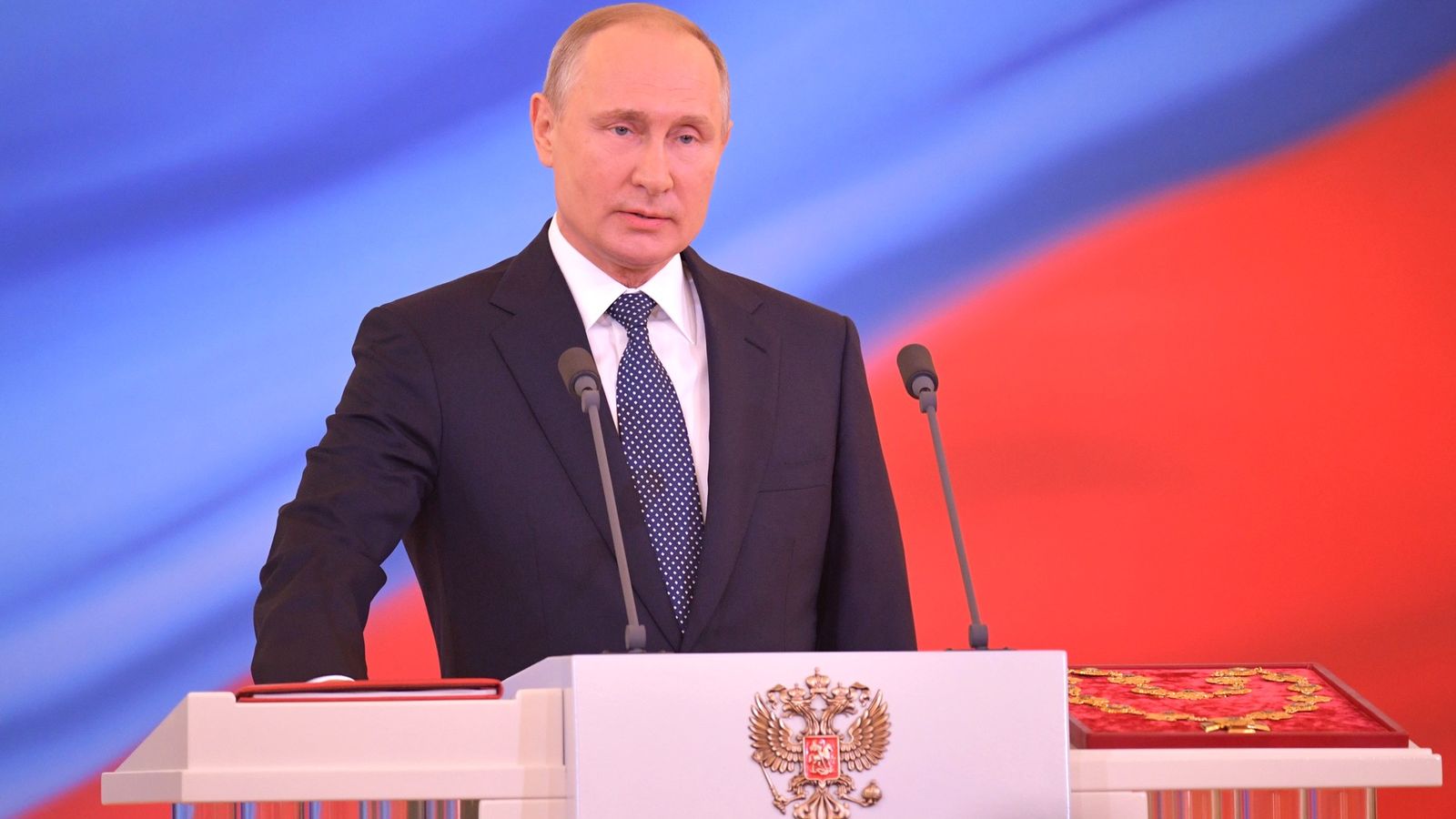
Across much of the world today, leaders on both the left and the right govern with the public barely tolerating them. Joe Biden left office with an approval rating of 36 percent. France’s Emmanuel Macron sits in the mid-20s. Germany’s Olaf Scholz managed to hit 20 percent before his governing coalition collapsed. For elected leaders accountable to voters, this is the grinding reality of modern democratic politics: you are judged constantly, and rarely kindly.
And yet Vladimir Putin, a man universally condemned across the international community for his authoritarian rule, is sitting north of 80 percent approval after a quarter-century in power and after launching a disastrous war in Ukraine. For more than two decades, he has perfected a formula that transforms every crisis into a popularity gain, every sanction into proof of Western hostility, and every military adventure into patriotic triumph, building what once looked like an indestructible machine powered by economic modernization, nationalist pride, and the systematic elimination of organized opposition.
Understanding Putin’s genuine popularity matters because it reveals how authoritarianism can actually work. It does not have to rest exclusively on repression and propaganda, though he has brought plenty of both to bear. It rests on building a system in which loyalty is produced not through Stalin-era forced devotion but by making the leader inseparable from patriotism itself, so that opposing the president is reframed as opposing Russian identity. This is the story of how Putin built the most durable authoritarian popularity in recent history, and why, increasingly, it might no longer be enough to see him through.
Situation Brief
- Putin’s approval has stayed above 80 percent for most of his rule even as Western leaders routinely sink into the 20s and 30s, the product of a deliberate formula rather than coincidence or pure fakery.
- His popularity was first built on a genuine economic recovery: real wages tripled between 2000 and 2008, GDP grew more than 7 percent a year, and poverty fell from 30 percent to 11 percent, much of it riding a fourfold rise in oil prices.
- His core technique is converting crisis into opportunity, from the 1999 apartment bombings and the Second Chechen War to the 2014 annexation of Crimea, each of which sent his ratings upward.
- His most powerful manipulation was fusing his rule with Russian cultural identity, so any opposition could be branded foreign and treasonous.
- Support is not a monolith: older “Soviet Memory” Russians and rural communities remain his base, while younger Russians and big-city residents are far more skeptical.
The Economic Collapse That Built Putin
To understand how Putin reached this point, you first have to grasp the sheer economic and psychological devastation Russians endured after the fall of the Soviet Union. The numbers tell a story of near-civilizational collapse. Russia’s GDP fell by nearly half in a matter of years, a contraction worse than the United States experienced during the Great Depression. Hyperinflation in the early 1990s hit 2,000 percent, wiping out the life savings of millions overnight, and real wages collapsed by an average of two-thirds.
The Soviet economy had never been a paradise. Its final decades did not see the mass starvation that scarred earlier years, but they did feature chronic shortages, long queues for staples as basic as bread, and endemic stagnation. What it offered was stability: people had jobs, and food was available if not abundant. The 1990s obliterated all of that.
The economy had for decades rested on enormous state subsidies that left the country deeply uncompetitive, and once those disappeared, the whole structure came crashing down.
The psychological blow was second only to the material one. The Soviet Union had spent nearly a century as one of the world’s two great powers, dominating the Eastern Bloc and serving as the only serious military rival to the United States, its influence spanning the globe from Havana just off the coast of Florida to Vietnam in East Asia. To go from that to economic ruin in the span of a decade was a humiliation that cut to the core of national identity.
Russia was not alone in suffering this transition. Ukraine endured an equally devastating collapse, and other Eastern and Central European countries were not spared either, though Central Europe bounced back far faster. That difference matters, because it shows authoritarianism was neither inevitable nor the only path.
Poland, the Czech Republic, the Baltic states, and others emerged from the same collapse as functioning democracies, and today they have healthier economies than Russia; Poland alone tripled its GDP. Russia, however, chose to forge its own path, one paved by a man the entire world would soon come to know.
Vladimir Putin first stepped into the public eye in 1999 as Russia’s new prime minister, hand-picked by President Boris Yeltsin. He was a political nobody at the time, a mid-level bureaucrat with an intelligence background who had spent the previous decade in the St. Petersburg mayor’s office. Before that, he had served sixteen years in the KGB, including a posting in Dresden that ended with him burning intelligence files as the Berlin Wall fell.
This was not the profile of a rising political star, nor of a reformer; the KGB was many things, but a school for liberal democrats it was not.
To his credit, Putin read the moment better than most Western observers believed he could. He understood that fixing the economy had to be the first priority, done at all costs. His early years stand in sharp contrast to how the same man runs the country today. He surrounded himself with a team of Western-trained economists who were, above all else, boring; they were not climbing onto tanks like Yeltsin or demanding renationalization like the holdover communists.
Their mandate was simple: stabilize the economy, then generate growth.
The key figures were Alexei Kudrin as finance minister and German Gref as economic development minister, both schooled in Western economic theory and committed to market reform. They implemented a flat 13 percent income tax that dramatically increased revenue by making evasion less worthwhile, created a stabilization fund out of oil revenues to cushion against price shocks, and, perhaps most importantly, enshrined property rights. The Soviet Union had never been a bastion of private ownership, and the 1990s had been an absolute mess of contested claims over who actually owned a given factory: the state, the workers, or the oligarch who had bought it.
Putin’s team built a legal framework that, while far from perfect, gave businesses and investors confidence that their assets would not be arbitrarily seized, and the 2002 Land Code finally permitted private ownership of land for the first time since the Bolshevik Revolution nearly a century earlier. These were not glamorous reforms, but they were genuine milestones toward a functioning market economy.
The results were genuinely impressive. Real wages more than tripled between 2000 and 2008, GDP growth exceeded 7 percent annually, making Russia one of the world’s fastest-growing major economies, and industrial production grew by more than 75 percent during Putin’s first eight years. The poverty rate dropped from 30 percent to 11 percent, and consumer credit became available for the first time.
Russia’s leaders deserve some credit, but they were not performing miracles. Much of the recovery came from oil prices nearly quadrupling, from roughly 25 dollars to over 100 dollars per barrel. This created a deep dependency on oil sales, but to most Russian citizens climbing out of a decade of disaster, that was a trivial detail.
Watch on HomeFronts
Watch the full video analysis on the HomeFronts YouTube channel, presented by Simon Whistler.
For many Russians, Putin became nothing short of a hero. The years of catastrophe in the 1990s were over, and a government that was uncharacteristically competent had arrived. State media worked overtime to reinforce the message, ensuring Putin received credit for every positive development while problems were dismissed or blamed on local officials and foreign meddling. Foreign investment poured in as the financial sector came to be seen as stable and profitable; between 2000 and 2008, foreign direct investment rose from 2.7 billion dollars to 75 billion dollars annually, with BP alone investing 8 billion dollars in the oil company TNK.
Russia even began paying down its crushing foreign debts, including what it owed the International Monetary Fund. By 2006, that debt was paid off entirely, ahead of schedule. Very few countries transform themselves that quickly.
In this era, it was easy to be lulled into a false sense of optimism. George W. Bush famously said in 2001 that he had “looked into Putin’s soul” and found him trustworthy, and German Chancellor Gerhard Schroder, while negotiating the Nord Stream I pipeline, called Putin a “flawless democrat.” Even after Russia’s 2008 invasion of Georgia, Chancellor Angela Merkel pushed ahead with Nord Stream II, integrating Russia’s energy production ever more deeply into European markets.
Yet for those willing to look, the early warning signs were there. The independent television network NTV was seized by the state in 2001 after criticizing the war in Chechnya. Journalists investigating the 1999 apartment bombings began dying under mysterious circumstances: Anna Politkovskaya was shot in her apartment building, and Alexander Litvinenko was poisoned with polonium in London.
Mikhail Khodorkovsky, then Russia’s richest man, was arrested in 2003 essentially for funding opposition parties. The message was unmistakable: political freedom was not around the corner, and after the collapse of the Soviet system Russia was simply transferring to a new style of autocracy. The prosperity was real, but so was the quiet construction of a system whose rules increasingly served one man.
Crisis as Opportunity
Russia’s economic turnaround, and the soaring popularity it produced, was not a one-off. Putin’s political genius lies in converting every crisis into a popularity gain, and the pattern has been remarkably consistent: identify a threat, project strength, claim victory, and watch as approval soars. The formula predates his presidency. In September 1999, a series of apartment bombings killed more than 300 Russians in cities ranging from Moscow to Buynaksk to Volgodonsk.
On top of the economic crises engulfing the country, it now looked as though the state could not even secure its own capital. Putin wasted little time, promising to “waste the terrorists in the outhouse.” Crude, certainly, but it resonated. He recognized that the country was passing through a period of weakness unprecedented in living memory, and he sensed exactly what would rally nationalist sentiment at home.
The official account held that Chechen separatists were responsible, a narrative that handed Putin the perfect justification for military action. Within weeks he had launched the Second Chechen War, in which he, not the sitting president, was presented as leading the military toward victory. The coverage was carefully choreographed: cameras followed Putin throughout, showing him inspecting troops and studying battlefield maps. Yeltsin had a well-known reputation for public drunkenness; Putin offered himself as the sober, competent alternative.
The war was neither short nor easy, dragging on for nearly a decade with a brutal insurgency phase, but the initial operations of 1999 and 2000 looked like victory to the Russian public. Russian forces retook the Chechen capital, Grozny, by February 2000. The human cost was staggering, with estimates suggesting as many as 25,000 civilians died in the first year alone, yet Russian media focused exclusively on military victories and Putin’s leadership. His approval soared from 31 percent in August 1999 to 84 percent by January 2000, just in time to assume the presidency after Yeltsin resigned and named him successor.
Through that first triumph, Putin demonstrated a deep understanding of the Russian public’s anxieties. The country has lived through repeated foreign invasions over centuries, from the Mongols to Napoleon to Hitler, each remembered as an existential struggle for survival. Over time this produced what historians call the “fortress Russia” mentality: enemies surround us, the wider world is hostile, and only strong leadership can ensure survival. When Putin frames conflicts as struggles against Western aggression, he activates these fears.
He has returned to this well repeatedly. When his approval sagged to 61 percent after the 2011 protests over alleged election fraud, the 2014 annexation of Crimea provided the crisis he needed; his ratings jumped to 86 percent overnight, reaching 89 percent by June 2015, the highest of his career. Even economic disasters became opportunities: when the 2008 global financial crisis cost the stock market nearly two-thirds of its value, Putin deflected responsibility onto Western capitalism rather than admit domestic failures, and used the crisis to justify greater state control over the economy.
But his greatest manipulation was not about external crises. It was about weaponizing Russia’s own cultural identity to make any opposition appear fundamentally treasonous.
The Fatal Policy Fusion
Putin’s most consequential maneuver was not about economics or foreign policy at all. It was the way he turned Russia’s social attitudes into a tool for delegitimizing any opposition as fundamentally anti-Russian. He grasped that economic modernization alone would not guarantee his power would last; what he needed was to make any opposition look like cultural treason, and the genius lay in how thoroughly he bundled his personal rule with Russian identity.
Early in his presidency, Putin positioned himself as a pragmatic modernizer, welcoming foreign investment and pushing for membership in the World Trade Organization. But around 2004, something shifted. The Orange Revolution in Ukraine showed him, much as the fall of the Berlin Wall once had, that popular movements could topple Moscow-friendly governments. He began constructing a new formula: you could have his style of government, or you could have chaos and Western domination. There was no middle ground.
To see how this worked, it helps to understand Russian public opinion. This is a far more socially conservative country than those of Western Europe, a disposition Putin did not create but certainly exploited. The revival of the Russian Orthodox Church became a central tool.
After decades of repression, often brutal, especially under Stalin, the Church experienced a renewal following the collapse of the USSR. With one of the world’s largest superpowers dissolved and state institutions in ruins, a vacuum opened for meaning, and the Church filled it, invoking an authority beyond this world that could not collapse merely because it was poorly governed. By 2007, 72 percent of Russians identified as Orthodox, up from 31 percent in 1992, a population searching for authority and meaning in tradition.
Putin recognized he could hijack this revival for political ends. The man who had served the officially atheist USSR for decades as a KGB officer suddenly presented himself as a public champion of Orthodoxy, and the Church reciprocated; Patriarch Kirill, who became its head in 2009, famously called Putin’s rule “a miracle of God.”
But the real innovation was not simply embracing conservatism. It was making any alternative seem, by definition, foreign. For a nation that has long seen itself as isolated from the West and suspicious of outside interference, that label resonated in ways Western audiences can struggle to appreciate.
In 2012, Russia passed a “foreign agents” law requiring NGOs that received foreign funding to register under that stigmatizing label; by 2025, more than 900 organizations had been branded this way, including Memorial, Russia’s Nobel Prize-winning human rights group that documented Soviet crimes. The message was clear: civil society opposition is foreign infiltration.
LGBT rights became a useful wedge in the same strategy. In 2013, the Duma passed the now-infamous “gay propaganda” law banning the “promotion of non-traditional sexual relationships to minors.” It polled at 88 percent support, in a period when most Russians readily accepted the idea that such movements were foreign threats.
Yet Russia, like every country, has LGBT citizens; Moscow itself had thriving gay clubs in the 1990s and domestic advocacy groups with no link to Western funding. Putin reframed these homegrown movements as foreign contamination, making support for any minority rights look like a betrayal of Russian identity.
This allowed him to redraw the entire political map. The opposition, in his telling, was offering wholesale Westernization that was neither welcome nor needed. In his own words: “We see how many Euro-Atlantic countries have taken the path of rejecting their roots, including Christian values. This is the path to degradation.”
How the Fusion Trapped Everyone
This fusion proved devastatingly effective. When protesters filled Moscow’s streets in 2011 and 2012 demanding fair elections, state media did not engage their actual demands, which were ending corruption, real political competition, and economic reform. Instead, coverage zoomed in on any rainbow flags in the crowd and highlighted which organizers had received Western grants. The message was unmistakable: these are not real Russians with legitimate grievances but agents of Western cultural imperialism.
It trapped even sophisticated opposition figures. Alexei Navalny, by nobody’s definition a liberal, spent years walking back earlier nationalist statements while trying not to alienate socially conservative Russians, and asked about LGBT rights he gave tortured non-answers about “letting regions decide.” The opposition could not articulate a vision both reformist and recognizably Russian, because Putin had made those categories mutually exclusive.
But here is the crucial part that often gets missed: this fusion would prove most valuable precisely when Putin began dismantling the very economic achievements that built his popularity. He rose to power promising prosperity through modernization, and GDP grew 72 percent in his first eight years. Then, facing the limits of his economic model and threats to his control, he doubled down on the strongman approach.
The 2014 annexation of Crimea traded economic development for nationalist confrontation with the West and triggered sanctions that cut Russia off from Western technology and investment, and the 2022 invasion completed the transformation, dragging Russia back into the isolated economic mold it had spent years trying to escape. Central Bank Governor Elvira Nabiullina reportedly offered her resignation after the invasion, fearing the fallout would undo the work of her entire career.
Even after the weaker-than-expected international response to the 2014 invasion of Crimea, Russians felt empowered, having come to trust Putin’s judgment based on previous conflicts that, despite occasionally dragging on, were ultimately portrayed as successes. Tapping the nationalist vein has paid off even with groups otherwise cool toward him. According to the Levada Center, more than two-thirds of Russians aged 18 to 24 describe themselves as patriots, far higher than in many European countries, a figure that actually increased during the war even as support for Putin personally fell among the same group.
All of this came at enormous cost. South Korea modernized dramatically after the lifting of martial law in 1987 while preserving a traditional culture, proving that economic development and democratization require neither a sweeping social revolution nor authoritarian rule. Western observers often miss this, assuming Russian opposition figures must all be liberal in the Western sense, a misreading that helps Putin.
Many who oppose him do so not because they want Western political systems, but because they want a competent, less corrupt, more prosperous Russia. In Putin’s binary world, there is no space for that combination.
Who Supports Him?
Putin’s support is not a monolith but a complex coalition held together by different hopes and fears, and understanding who backs him reveals both how he has stayed popular for so long and how fragile his position has now become. A headline figure such as 86 percent approval can mislead, because that support is not spread evenly across society. First, though, it is worth asking how much we can trust the numbers at all.
We have all seen the suspicious tallies that come out of certain authoritarian states. Belarusian President Alexander Lukashenko won re-election with 81 percent amid widespread reports of ballot stuffing, Syria’s Bashar al-Assad took 92 percent in 2014, and Saddam Hussein once ran a yes-or-no referendum on his presidency in which he received, of course, 100 percent “yes” votes. Russia is different.
We cannot pretend its elections are free of fraud, and there is undeniably considerable repression of the opposition, but independent institutions such as the Levada Center have been able to conduct generally reliable polling. Researchers who try to correct for fear-based lying using anonymous techniques have found that Putin’s support might be inflated by 5 to 10 percent, yet even then a clear majority still backs him. What the data shows are stark demographic patterns that tell stories about generational experience, geographic isolation, and fundamentally different relationships with information and authority.
The starkest divide runs along generational lines: your relationship with Putin depends largely on how you remember Russia before the collapse of the USSR, or whether you remember it at all. Those over 55 form his most reliable base, with approval consistently above 70 percent and at times reaching the mid-80s. These Russians, sometimes called the Soviet Memory Generation, lived through genuine superpower status, when their country stood on par with Washington.
The Soviet economy had chronic problems, but those looking back tend to remember selectively; what they are nostalgic for is not Soviet reality but the feeling of mattering on the world stage. For this generation, Putin’s expansionist policies represent a return to those “glory days,” and research shows 80 percent of Russians felt their country was a “superpower again” after the Crimea invasion. Just as importantly, they remember the chaos of the 1990s vividly.
For them, Putin is not merely a president; he is the man who saved Russia from dissolution, and that gratitude runs deep and has proven remarkably durable even as current policies fail.
The polar opposite is the so-called Putin Generation, Russians under roughly 35, for whom Putin has stood at the center of politics their whole lives. They have little or no memory of the Soviet Union, and rather than comparing their country to the chaos of the 1990s or the might the USSR once projected, they compare it to the countries around them. By that standard, Russia looks increasingly isolated and behind the times.
Here Western observers repeatedly stumble. They assume this generational shift will unfold as it has in their own countries, with younger people adopting a more liberal, cosmopolitan worldview. In Russia, that is not what is happening.
Young Russians have shown a defiant tendency to remain intensely patriotic while expressing little approval for Putin’s presidency. They are proud to be Russian, yet only 48 percent express confidence in Putin personally, a remarkable 34-point gap between national pride and approval of the leader, far larger than in Western democracies. For comparison, only 41 percent of young Americans say they are proud to be American, and a similar share of young Britons say the same.
Young Russians have kept a strong national identity while becoming far more critical of Putin personally, exactly the distinction he spent years trying, and failing, to erase with this generation.
The urban-rural divide is equally dramatic. Moscow and St. Petersburg consistently post the lowest approval ratings, typically in the 50s or low 60s, still high by Western standards but a world away from rural areas and small cities, where approval routinely tops 70 percent and can reach the 80s or 90s.
This reflects more than uneven access to information. Across Russia’s vast countryside and its single-industry towns, the state remains the primary source of employment and services. A teacher in rural Siberia does not merely work for a state school; she lives in state-subsidized housing, shops at state-supported stores, and watches state television as her window onto the wider world.
Both her livelihood and her information are anchored to the state. For much of his presidency, Putin’s popularity waned at times but could always be restored through one crisis or another, until the invasion of Ukraine in 2022.
The Ukraine Crisis
The February 2022 invasion of Ukraine was meant to be another step in Putin’s crisis playbook: a quick military victory, a surge of patriotic support, a strengthened political position. To some extent it worked, but not as planned, and not indefinitely. Putin’s approval jumped from 69 percent in January 2022 to 83 percent by March, a solid 14-point gain.
State television ran around-the-clock coverage of the “special military operation,” framing it as both a defensive action against expansionist NATO forces and a campaign against “Ukrainian Nazis.” Despite failing to achieve any of its original objectives, and despite every sign that the operation would take far longer than planned, the rally-around-the-flag effect appeared to be working.
But support for Putin and support for the war were never the same thing. Even in March 2022, at the peak of war fever, only 53 percent of Russians “definitely supported” the operation, with another 28 percent merely “somewhat” supportive. Putin’s personal approval hit 83 percent, a 30-point gap between belief in the leader and belief in his war.
This is not to suggest widespread open opposition; Putin retained the trust of many, and a great many Russians simply went along with it. But the support was a mile wide and an inch deep, enough to sustain the war politically yet far short of the zealous enthusiasm the Kremlin had hoped for.
For the first year, that shallow support proved surprisingly durable. Even as the promised “three-day special operation” stretched into months; even as Russian forces retreated from Kyiv in a humiliating defeat; even as the Black Sea Fleet lost its flagship to a country without a navy, Putin’s approval remained above 80 percent. The September 2022 “partial mobilization” caused some domestic unrest but registered more as an international embarrassment than a genuine crisis; his approval dipped only to 77 percent.
Why did predictions of Putin’s imminent downfall keep failing? Because they misunderstood what held his regime together. It was never just fear, propaganda, and repression, though all of those played a role.
The deeper truth is that Russians had internalized Putin’s political fusion, and even those who privately opposed the war could not bring themselves to say so out loud, because to do so felt like sounding anti-Russian. Consider the rapper Timati, who had previously clashed with Putin: after the invasion, he posted a viral message about the need to support your country in wartime regardless of whether the cause is just, even saying he preferred to imagine Russia was genuinely under threat from NATO to justify it all. He was hardly alone.
The formula that had trapped the opposition now trapped ordinary citizens: you could support Russia’s war, or you could side with the West against your own country. The possibility of being a patriotic Russian who opposed the war, a position held privately by millions, had been erased from public discourse.
But from late 2024 into 2025, that formula began to break down, not from any single traumatic event but from the slow accumulation of costs that could no longer be hidden.
The Costs That Cannot Be Hidden
The scale of this conflict is staggering. With total casualties increasing by more than 1,000 per day according to Western intelligence estimates, Russia is losing men faster than it can replace them; Ukrainian officials put the figure even higher, at an average of 1,286 per day.
Moscow has sustained recruitment through massive financial incentives, often targeting poorer regions. Sign-up bonuses that began at 200,000 rubles now exceed 5 million in some areas, just for enlisting, and for many Russians the monthly military salary is the most lucrative career prospect available. This held the line, drawing recruits and placating unrest with generous death benefits, but even this has limits now in sight.
Military recruitment fell 65 percent in the first quarter of 2025 compared with 2023, and by more than 80 percent in Moscow. The pool of those willing to enlist for purely patriotic reasons has been exhausted, and to keep the war machine fueled Putin has turned to enlisting North Korean soldiers.
The elite consensus that once underpinned his rule is fracturing at unprecedented speed. July 2025 alone saw a cascade of suspicious deaths and arrests that shocked even cynical Moscow observers. Transport Minister Roman Starovoit’s apparent suicide on July 8 followed a grim pattern of officials who questioned the war’s resource allocation suddenly turning up dead, and oligarch Konstantin Strukov was arrested while attempting to flee to Turkey with 200 billion rubles in assets. Since January 2025, seven senior officials and three oligarchs have died under mysterious circumstances, a clear message that even decades of loyalty no longer guarantee safety.
The impatience has not been confined to the home front. US President Donald Trump, who long campaigned on a promise to end the war in Ukraine before even taking office, has grown openly exasperated with Putin’s unwillingness to negotiate in good faith, and in a notable reversal has begun taking a harder line against Moscow. For Putin, this is a major geopolitical loss, given the affinity Trump has controversially expressed for him. Trump’s administration entered the year eager to broker a deal that allegedly would have recognized several concessions from Kyiv to Moscow in exchange for an international security corridor, policed by European soldiers, to prevent further violence against Ukraine.
The economic situation is closing in as well. The enormous military spending that initially cushioned the war’s impact is not sustainable: defense spending for 2025 consumes 41 percent of the federal budget, up from 14 percent in 2021, with education, healthcare, and infrastructure all sacrificed to feed a war machine that clearly cannot deliver victory. Even more tellingly, the state has begun hiding statistics behind “state secrets” provisions. In January 2025, Putin signed a law making all military casualties state secrets, and regional governments must now conduct military funerals at night, a sharp contrast with 2014, when soldiers who died taking Crimea were publicly honored as heroes.
The gap between war support and Putin’s approval has only widened. January 2025 polling shows Putin maintaining 74 percent approval, yet only 41 percent of Russians now “definitely support” continuing the conflict, and among those under 30 the figure drops to just 19 percent. More striking still, when asked in anonymous online polls whether Russia should “accept territorial losses to end the war,” 34 percent now say yes, a level unthinkable a year earlier.
Russia has held off the worst impacts for longer than most thought possible, yet some of the architects of these plans are signaling that the system is nearing a breaking point. Central Bank Governor Elvira Nabiullina warned in the autumn of 2024 that Russia’s overheated war economy was “running on empty.” Tens of thousands more soldiers have died since, and the labor shortage she described has hardened into a crisis that will not ease while the war rages.
The Formula Turns on Itself
For a quarter-century, Putin maintained a political formula that seemed to defy gravity. Every crisis became an opportunity, every setback proof of his necessity, every foreign condemnation evidence of his strength. Even now, with Russia bleeding men at a staggering rate, the economy cannibalizing itself, and former allies fleeing or dying mysteriously, his approval remains higher than most democratic leaders could dream of.
He remains what he has been for 25 years: the irreplaceable man in Russian politics. That is not strength but the most dangerous weakness of all, because in systems where everything depends on one man, when that man finally falls, everything can fall with him.
But the war Putin launched to shore up his support is starting to cut into the very foundations of his political capital. Russia cannot sustain the recruitment numbers this battle demands indefinitely, and that reality is setting in. Ironically, it is Putin himself who has demonstrated Russia’s growing dependence on foreign powers through his recruitment of North Korean soldiers, exactly the kind of dependence his entire political brand was built on rejecting. With every passing day the war drags on, the economic recovery he spent years solidifying continues to unravel, and the formula that generated authentic popular support over decades is now systematically destroying the conditions that made it possible.
Putin’s approval ratings may stay high for now, but they reflect a tangled reality: genuine gratitude mixed with resignation, authentic patriotism combined with a fear of speaking out, pride in Russian strength alongside private doubts. The numbers capture support but not enthusiasm, acceptance but not hope. Bankruptcy, it has often been said, happens slowly, and then all at once. Putin’s political formula, as impressive as it has been, may soon discover that firsthand.
Simon Whistler
Simon Whistler is one of YouTube's most prolific educational creators. HomeFronts is his deep dive into geopolitics, modern conflict, military history, and the civilian and societal dimensions of global events.
Frequently Asked Questions
Why is Vladimir Putin so popular when Western leaders are not?
His high approval, north of 80 percent for much of his rule, rests on a deliberate formula. He built early legitimacy on a genuine economic recovery, learned to convert each crisis into a surge of patriotic support, and fused his personal rule with Russian identity so that opposing him came to feel like opposing Russia itself. Repression and propaganda reinforced this, but the popularity also reflects real gratitude among those who remember the chaos of the 1990s.
Are Putin’s approval ratings real or just propaganda?
They are more credible than the implausible tallies seen in Belarus, Syria, or Saddam Hussein’s Iraq. Independent institutions such as the Levada Center conduct generally reliable polling, and researchers using anonymous techniques to correct for fear-based lying have found his support may be inflated by only 5 to 10 percent. Even after such adjustments, a clear majority still backs him, though that support is often shallow rather than enthusiastic.
How did Russia’s economy recover under Putin, and what is his “crisis as opportunity” strategy?
Western-trained economists, including Alexei Kudrin and German Gref, stabilized the economy with a flat 13 percent income tax, an oil-funded stabilization fund, stronger property rights, and the 2002 Land Code allowing private land ownership; real wages tripled between 2000 and 2008 and poverty fell from 30 percent to 11 percent, though much of the boom rode a near-quadrupling of oil prices. His parallel political technique is to identify a threat, project strength, claim victory, and watch approval rise, as he did with the 1999 apartment bombings, the Second Chechen War, and the 2014 annexation of Crimea, each of which sent his ratings sharply upward.
Why don’t young Russians turn liberal like young people in the West?
In Russia, younger people remain strongly patriotic while becoming sharply more skeptical of Putin personally. Only 48 percent express confidence in him, a 34-point gap between national pride and leader approval. They compare Russia not to the Soviet past but to neighboring countries, and by that measure they see a nation that looks isolated.
How did the invasion of Ukraine affect Putin’s popularity?
It initially boosted his approval from 69 percent in January 2022 to 83 percent by March, but it exposed how shallow war support really was. Even at peak enthusiasm, only 53 percent “definitely” supported the operation, and by early 2025 that figure had fallen to 41 percent overall and just 19 percent among those under 30, even as Putin’s personal approval held around 74 percent.
What signs suggest Putin’s popularity may be unsustainable?
Recruitment has collapsed, falling 65 percent in early 2025 nationally and more than 80 percent in Moscow, forcing reliance on North Korean soldiers. Defense spending consumes 41 percent of the 2025 federal budget, up from 14 percent in 2021, crowding out healthcare, education, and infrastructure. Casualties mount by over 1,000 per day, military deaths have been classified as state secrets, and a wave of suspicious elite deaths and arrests signals fracturing loyalty.
Sources
- Newsweek — Donald Trump approval rating, Gen Z, 2025
- Gallup — American pride slips to new low
- Axios — Biden, Trump, Gen Z and millennial poll
- Newsweek — Russia casualties in Ukraine near one million
- The Guardian — Iraq referendum, 2002
- Holodomor Museum — Timati, Russian singer
- The Wall Street Journal — Putin, Russia population and birthrate
- openDemocracy — Putin and the rural roots of authoritarian populism in Russia
- The Wall Street Journal — Putin’s approval rating jumps after invasion
- The Telegraph — Fears Putin will turn Russia into outright dictatorship
- RFE/RL — Putin’s 70th birthday, mobilization, popularity
- Al Jazeera — Why Putin’s approval rating is falling
- Carnegie Endowment — How authentic is Putin’s approval rating?
- Russia Matters — Young Russians express growing disapproval of Putin
- Atlantic Council — Reluctant consensus: war and Russia’s public opinion
- Russia.Post — Ratings of Putin
- The Wall Street Journal — With risks rising at home, Putin takes anti-Western rhetoric to new heights
- Freedom House — Russia, Freedom in the World 2025
- Chicago Council on Global Affairs — Three in four Russians expect military victory over Ukraine
- New York Post — Russian army recruitment drops 80% in Moscow


